
From Handheld Scanners to Drones: Improving Warehouse Efficiency Through WMS & ERP‑Aligned Labelling and Signage

In logistics, 3PL, manufacturing, and high‑bay warehousing, scanning technology forms the physical interface between warehouse execution and digital systems such as Warehouse Management Systems (WMS) and Enterprise Resource Planning (ERP) platforms.
From rapid throughput and tight Service Level Agreements (SLAs) to complex storage configurations and safety requirements, these environments depend on fast, accurate, and repeatable scanning to keep systems updated in real time.
While scanner technology continues to evolve, WMS and ERP performance ultimately depends on how well physical labels and signage are planned, standardised, and maintained. Poor labelling creates data errors, system exceptions, and manual workarounds — reducing the value of even the most advanced software platforms.
Scanner Types and Their Role in WMS / ERP Integration

1. Handheld Scanners (Logistics & Manufacturing)
Handheld barcode scanners remain critical touchpoints between physical operations and digital systems. They support WMS and ERP functions such as:
Inbound receivals and ASN validation
Work‑in‑progress (WIP) and production tracking
Dispatch confirmation and shipment accuracy
Quality and compliance checks
In integrated environments, a single scan often triggers multiple system transactions — inventory updates, location confirmations, and order status changes. Inconsistent or poorly placed labels increase scan failures, leading to transaction delays, correction workflows, and reduced system trust.
2. Wearable Scanners (3PL & High‑Throughput Picking)
3PL operations rely heavily on WMS‑driven picking logic to meet customer SLAs. Wearable scanners enable fast, hands‑free execution of system‑directed tasks such as batch picking, zone picking, and replenishment.
To support this, labelling must align precisely with WMS location logic:
Consistent location naming conventions
Uniform barcode orientation and size
Clear rack, level, and position identifiers
When labels are inconsistent, wearable scanning performance drops, increasing mis‑picks and WMS exceptions — particularly in multi‑client 3PL facilities.
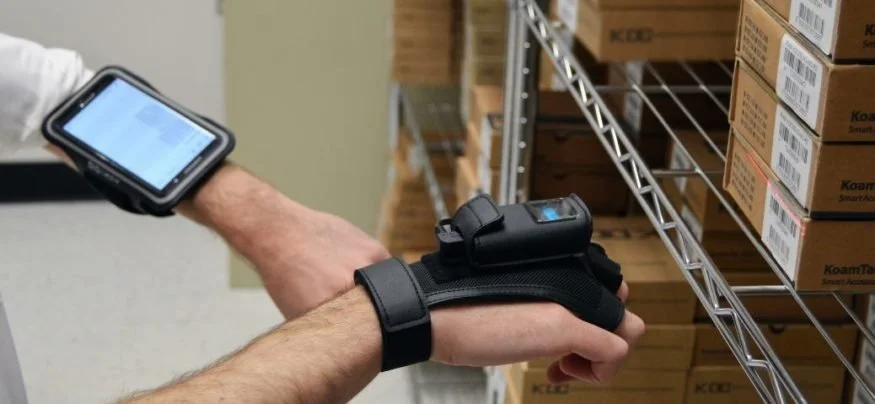
3. Fixed Scanners (Sortation & Automation Interfaces)
Fixed scanners are tightly integrated with WMS, WCS (Warehouse Control Systems), and sometimes ERP platforms. They automate:
Conveyance tracking
Sortation decisions
Dock door and shipment validation
Because these scanners operate without human intervention, they are entirely dependent on accurate label placement and readability. Poor labelling causes missed reads, system alerts, and manual overrides — directly impacting throughput and system reliability in automated environments.
4. Mobile Computers (Manufacturing & Complex Warehousing)
Mobile computers combine scanning with real‑time system interaction, enabling operators to execute ERP and WMS tasks such as:
Inventory verification and adjustments
Replenishment confirmations
Production staging and material issue
In manufacturing environments where ERP systems manage batch, lot, or serial data, clear physical signage and location labels reduce scanning errors between similar items and ensure transactions are posted accurately to the correct system records.

5. RFID Scanning (Large‑Scale Manufacturing & 3PL)
RFID technology integrates with WMS and ERP platforms to support high‑volume tracking of pallets, cartons, and returnable assets. While RFID reduces the need for individual line‑of‑sight scans, physical labelling and signage remain essential for:
Visual confirmation during exception handling
Mixed RFID/barcode workflows
Supporting operators when system validation is required
Clear location identifiers ensure RFID‑generated data aligns accurately with WMS inventory records.
Why Labelling & Signage Are Critical to System Performance
Data Accuracy and System Integrity
WMS and ERP systems depend on accurate scan data. Clear, standardised labelling reduces:
Transaction errors
Inventory variances
Manual data corrections
Well‑designed labels ensure that physical movements are correctly reflected in digital records.
High SKU Density and Dynamic Slotting
Logistics and 3PL warehouses often rely on system‑driven slotting and re‑slotting. Logical label sequencing and standard location formats allow WMS location changes to be executed without physical confusion, even during peak demand or labour changes.
High‑Bay and Complex Storage Alignment
High‑bay, narrow aisle, and VNA environments challenge both scanning hardware and system logic. Labelling designed for scan distance, dual‑access locations, and consistent vertical alignment ensures WMS‑directed tasks function correctly at height and at speed.
Safety, Compliance, and System Controls
Integrated signage supports not only WHS compliance but also system rules — reinforcing restricted zones, controlled inventory areas, and safe movement paths. This reduces unsafe scans and prevents system transactions from being executed in incorrect or prohibited locations.
Faster Training and Workforce Scalability
In WMS‑driven operations, productivity depends on how quickly staff can follow system instructions. Clear, intuitive labels and signage reduce onboarding time, minimise user errors, and allow operators to trust system prompts — particularly important in high‑turnover environments.
Drone Scanning and System Integration
Supporting WMS‑Driven Inventory Accuracy
Drone‑based scanning increasingly integrates directly with WMS platforms for:
Cycle counting
Stock validation
High‑bay inventory audits
This enables inventory updates without shutting down operations or deploying lifting equipment.
Labelling Remains the Foundation
Drone scanning accuracy depends entirely on label quality:
Outward‑facing, unobstructed placement
Camera‑readable barcode sizing and contrast
Consistent formats aligned to WMS location logic
Without standardised labelling, drones produce incomplete or unreliable data — undermining system confidence.
Best‑Practice Approach
Traditional scanners drive real‑time WMS and ERP execution
Drone scanning enhances audit accuracy and inventory confidence
Unified labelling standards ensure both technologies feed reliable data into the same systems
Conclusion
In logistics, 3PL, manufacturing, and high‑bay warehouse environments, WMS and ERP systems are only as reliable as the physical labelling and signage that feed them. Whether supporting handheld scanners, automated fixed readers, or drone‑based audits, consistent and system‑aligned labelling enables:
Accurate real‑time data
Higher throughput and compliance with SLAs
Safer operations and reduced exceptions
Lower training costs and fewer system errors
As warehouses become more automated and system‑driven, fit‑for‑purpose labelling and signage are no longer operational accessories — they are critical infrastructure.
If you’re facing challenges aligning your warehouse labelling with your WMS or ERP, ZOLT Group can help.
We specialise in designing identification systems that integrate seamlessly with your technology, processes, and growth plans.
Get in touch todayto build a more accurate, scalable, and system‑ready warehouse operation.